
Reviewed · CHEESE WALKING AND FOOD TOURS
Rotterdam & Gouda Private Daily Walking Tour
Rotterdam and Gouda make an excellent odd-couple pairing: one is a forward-looking port city of bridges and daring buildings, the other a compact old town of cheese, canals, churches, and narrow lanes. This private tour puts both in one day, with guide Aleks leading a group of no more than four.
I like the personal scale and the range. You get Rotterdam’s Markthal, cube houses, harbor, and Erasmus Bridge, then Gouda’s cheese experience, medieval center, and working flour windmill. I also like that the tour can be adjusted around hotel pickup. The main caution is time: 28 stops in seven hours means many visits are brief, and several entrance fees and public transport costs are extra.
Key points at a glance
- Two very different Dutch cities in one day: Rotterdam supplies modern architecture and maritime stories, while Gouda delivers old streets, churches, and cheese culture.
- A genuinely private format: The group is limited to four, giving you more room to ask questions and request small changes.
- Aleks brings the tour to life: A family who took the tour praised his storytelling, local routing, and ability to smooth out problems during the day.
- The Gouda Cheese Experience is the main paid highlight: It combines entertainment, tasting, and education, but costs €16 per person.
- The Red Lion windmill admission is included: This is one of the few listed interior visits covered in the tour price.
- Expect a fast-moving day: The schedule favors orientation and variety over long museum visits or leisurely meals.
Why this Rotterdam and Gouda pairing works
Rotterdam is not a city you understand from one postcard view. Its center was heavily damaged during the bombing of May 1940, and much of what you see today reflects rebuilding, experimentation, and a practical relationship with water.
Gouda gives you the other side of Dutch city life. Its center holds old civic buildings, guild connections, religious sites, charitable institutions, and commercial spaces. The contrast is useful: in Rotterdam, you look up at bridges and new architecture; in Gouda, you slow down to examine doorways, façades, courtyards, and old market buildings.
I would choose this tour if you want a broad first look at both places rather than a deep visit to either one. The private format helps, since Aleks can explain the changing pace and answer questions as the day moves from city streets to harbor edges and then to Gouda.
The tour begins at 9:00 a.m. at Rotterdam’s port area on Wilhelminakade. Pickup may also be arranged from a hotel in Rotterdam or Gouda, and from select Amsterdam locations including Amsterdam Central Station, the passenger terminal, or Dam Square. Confirm the exact pickup plan before setting out.
More Cheese Walking and Food Tours in the Netherlands
- 2-Hour Walking Tour in Gouda All inclusive
★ 5.0 · 48 reviews - Amsterdam Walking Tour and Cruise with Drinks and Cheese Tasting
★ 4.0 · 30 reviews - Amsterdam canal cruise with culinary burger or cheese & wine
★ 4.2 · 29 reviews
Rotterdam Centraal and the city rebuilt
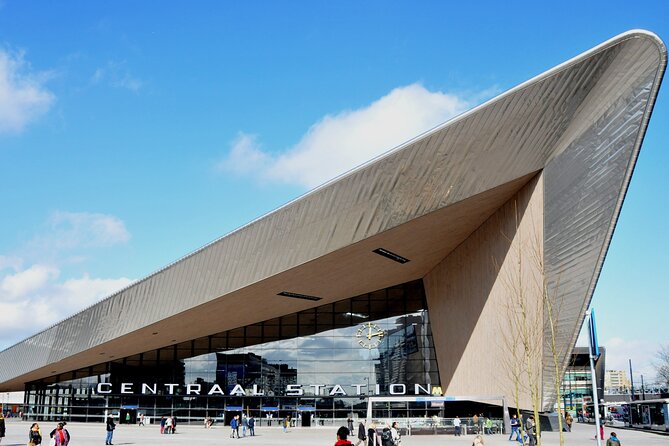
The first stop is Rotterdam Centraal Station, a sharp piece of modern architecture that handles about 170,000 passengers a day. You get only around ten minutes here, but that is enough to take in the angular design and understand the station as one of Rotterdam’s major visual markers.
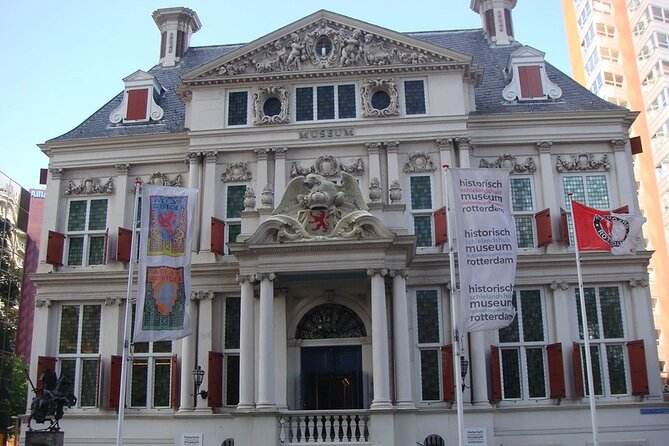
From there, the route moves into older civic and religious traces. The former headquarters of Waterschap Schieland and Krimpenerwaard occupied a 17th-century building tied to water policy and management in this part of South Holland. Napoleon Bonaparte once stayed there temporarily, which gives Aleks a useful story to attach to an otherwise easy-to-miss façade.
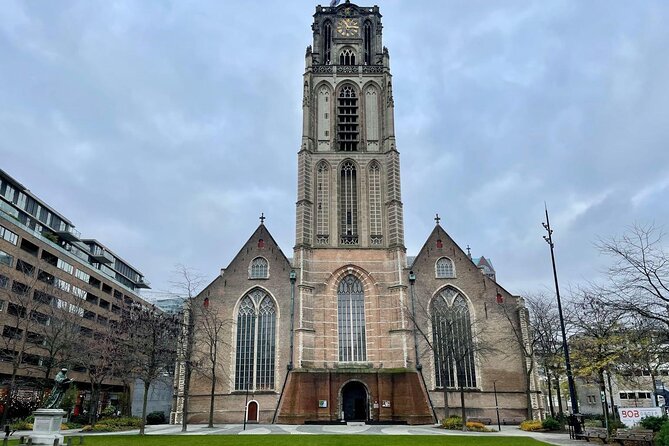
The Grote of Sint-Laurenskerk is especially important. Built in late Gothic style in 1525, it is Rotterdam’s oldest building and one of the few structures in the city center to survive the 1940 bombing. The scheduled stop is only ten minutes, and admission is not included, so you should decide ahead of time if you want to pay to enter.
I like this early section because it prevents Rotterdam from becoming only a parade of new buildings. You see the city’s older roots before the tour turns fully toward modern design.
Markthal, cube houses, and the old harbor
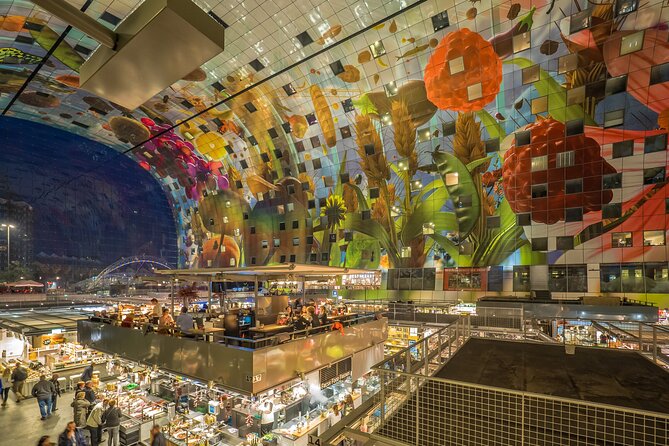
The Markthal is one of Rotterdam’s most recognizable newer buildings. Its horseshoe form combines an indoor market with apartments and other facilities. The colorful interior has earned it the nickname the Sistine Chapel of Rotterdam, though you should think of that as a playful comparison rather than a substitute for the real thing.
The scheduled visit lasts about 15 minutes and is free. That is enough for a look around, but not much time for a full food stop. If you want to buy something to eat, ask Aleks how that fits the day, since the itinerary continues quickly.
Next comes Kijk-Kubus, the cube-house complex designed to resemble trees, with cube-shaped apartments perched on supporting columns. The unusual shape leaves only about three-quarters of the interior space suitable for ordinary use. A 20-minute stop with admission included gives you more time here than at many of the outdoor landmarks.
This is one of the better places to ask practical questions about architecture. The cube houses are not just a photo stop. Their tilted walls and limited usable space raise an everyday question: how do people actually live in such a design?
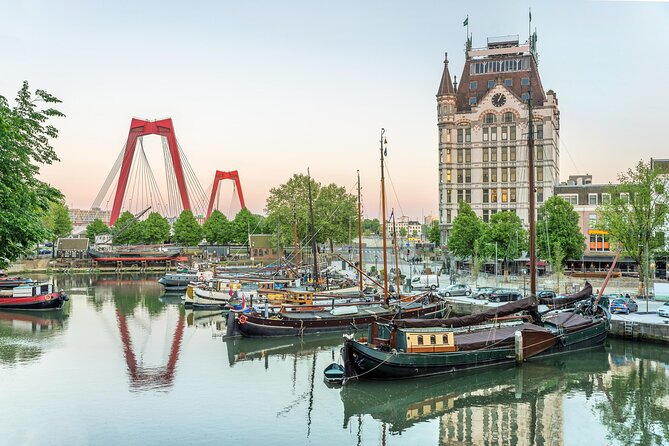
At Oude Haven, you reach one of Rotterdam’s oldest medieval ports, at the former mouth of the Rotte River where it met the New Meuse. Today, it is lined with cafés, restaurants, taverns, and clubs. The tour allows 20 minutes, enough to see the setting and understand how an old working harbor became a social district.
Nearby Witte Huis was once the tallest skyscraper in Europe at the end of the 19th century. It also survived the 1940 destruction. I find this a useful reminder that Rotterdam’s love of height and engineering did not begin with the latest towers.
Bridges, wartime memory, and the New Meuse
The route then crosses Rotterdam’s bridge story, moving through structures that connect the city physically and historically.
Willemsbrug, known as the Red Bridge, links the central and northern parts of Rotterdam with southern districts. It is one of three bridges serving that connection and is dedicated to Willem III. The stop is short, about ten minutes, but the bridge is a clear example of how transportation shapes the city.
De Hef is more industrial and more distinctive. Its name means the lift, and the steel structure once functioned as a lifting and rotating railway bridge across the New Meuse. It was used before the rail tunnel was built beneath the river. You do not need a long visit to appreciate it, but the explanation helps you see it as working infrastructure rather than just a photogenic relic.
At the monument to the merchant navy, known as de Boeg, the tone changes. The memorial on the right bank of the New Meuse honors the 3,500 people aboard Dutch merchant ships who died during World War II. The ten-minute stop gives the day a needed pause. Rotterdam’s port was not only a source of wealth and movement. It was also caught up in wartime danger.
Leuvehaven offers another look at the city’s maritime identity. The open-air maritime museum includes steamships, cargo-handling machines, ship engines, and other objects from the mid-19th century through the 1970s. Admission is listed as free, and the planned visit is about 20 minutes.
That timing is the limitation. I would not expect to study every ship or machine in detail. Think of Leuvehaven as a compact introduction to Rotterdam’s working waterfront, with the option to return on another visit if ships and industrial equipment are your main interest.
Same region, a different board:
- Amsterdam Classic Saloon Boat Cruise with Drinks and Cheese
★ 5.0 · 31,825 reviews - Amsterdam: Classic Saloon Boat Cruise with Cheese & Wine
★ 4.6 · 27,035 reviews - Amsterdam: Guided Zaanse Schans, Windmills & Cheese Tour
★ 4.4 · 4,826 reviews - Zaanse Schans Windmills, Clogs and Dutch Cheese Small-Group Tour from Amsterdam
★ 4.5 · 2,369 reviews
The Erasmus Bridge and the Rotterdam finale
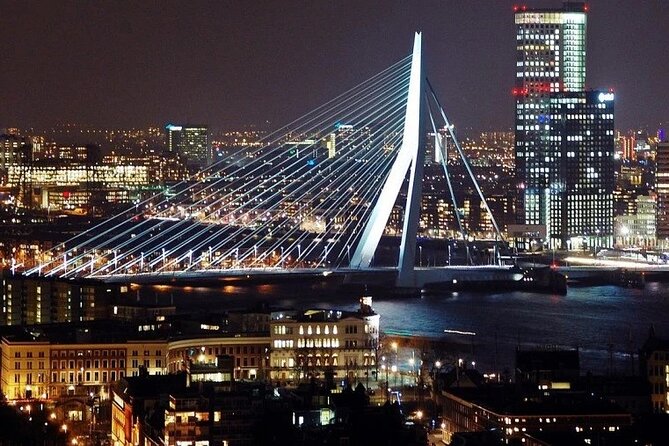
The Erasmus Bridge is the visual climax of the Rotterdam portion. This suspension bridge crosses the New Meuse and is widely known as the Swan or the Harp. Its pylon rises 139 meters, and its opening section is 80 meters long, described as the largest and heaviest opening section of its type in Europe.
The stop lasts about 20 minutes and is free. You get time for views and photographs, but not a long river walk. I like ending the Rotterdam section here because the bridge brings together nearly every theme introduced earlier: water, engineering, movement, postwar construction, and the city’s appetite for bold forms.
Transportation is part of the seven-hour tour, so this is not seven hours of continuous walking. That matters. You will walk around the sites, but you will also spend time moving between Rotterdam and Gouda and between parts of Rotterdam. Comfortable shoes still make sense, but this is not a single long walking route.
Gouda cheese with a side of history
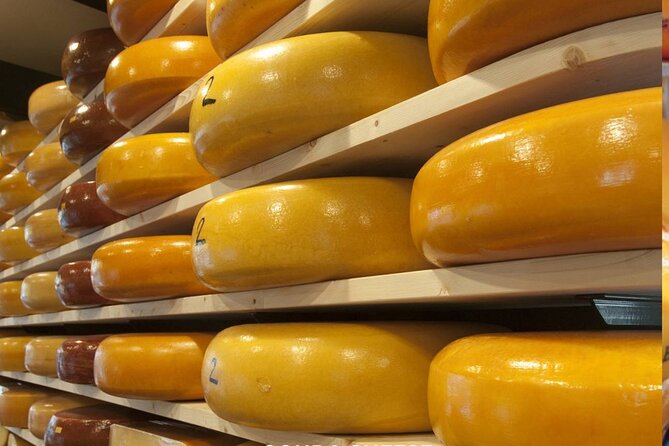
The Gouda Cheese Experience is the main paid attraction in the second half. It combines entertainment, tasting, and education in a museum and factory setting. Admission costs €16 per person and is not included.
I would budget carefully here. A cheese tasting can easily become the moment that pushes the day from sightseeing into shopping, and one family who took the tour was still enjoying the cheese they bought afterward. If you like Dutch food culture, this is likely to be one of the most memorable parts. If you are watching costs or prefer old buildings to food attractions, you may want to ask how much time is available before committing.
Gouda’s Stadhuis, or city hall, dates from 1459 and is described as the oldest existing city hall building in the Netherlands. The planned visit is 15 minutes, and admission is not included. The VVV Gouda building, once a customs house connected with the cheese trade, dates from 1668 and receives another 15-minute stop.
Arti Legi adds another layer to the town’s civic story. It has served several purposes over time, and the short visit works best as part of the walking tour’s larger pattern: Gouda’s old buildings often changed function as the city changed.
Churches, courtyards, and former institutions
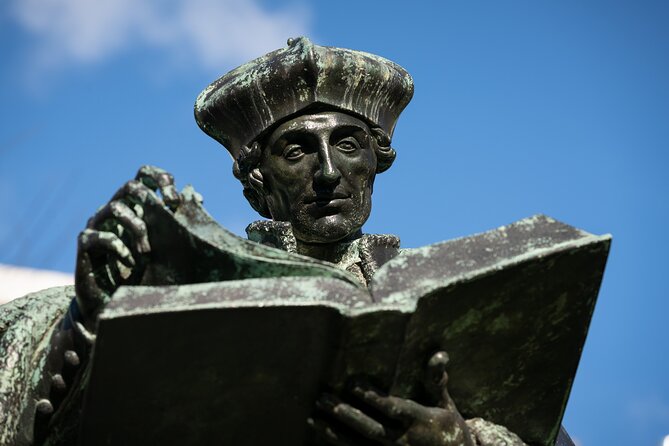
Saint-John Church is famous for its 72 stained-glass windows and is the longest church in the Netherlands. The visit is scheduled for ten minutes, while admission costs €11 per person.
That fee is worth considering if stained glass matters to you. Ten minutes is brief for a church of this importance, so ask Aleks whether the timing can be adjusted. The supplied schedule is full, but a private tour gives you a better chance of discussing priorities.
Museum Gouda occupies two buildings joined into one national monument. The site has served as a mental hospital, prison, torture chamber, art building, and horse stable. Admission is not included, and the planned stop is 15 minutes. You should see this as a quick introduction, not a full museum visit.
Tapijthuis sits in the oldest city quarter. It was once a workshop for Flemish tapestry weavers, later a secret Catholic children’s school, then a 19th-century brewery, and finally an art studio and gallery. A ten-minute stop is enough to appreciate the building’s changing uses.
The garden behind the Willem Vroesenhuis offers a quieter moment. The institution was founded by the prominent citizen Willem Vroesen as a home for older people. Lazaruspoortje, a five-minute stop, marks the former house for people with leprosy. These smaller places may not make your shortlist before the tour, but they help you see how Gouda organized care, work, faith, and trade.
Gouda’s working past in small details
The Visbanken, a former fish market established in the mid-16th century, receives only five minutes. The Evangelical Lutheran church is dedicated to Saint Joost, patron of bag carriers and their guild, and gets ten minutes.
Asschuur is an especially good example of a building whose name tells you what it did. This 19th-century house served as an ash warehouse when potash was used in making soap and glass. It is a small detail, but these are the kinds of details that make a town feel practical and lived-in rather than frozen in a postcard pose.
The Red Lion windmill, or Molen De Roode Leeuw, is the included interior visit in Gouda. It is one of the oldest surviving flour mills in the Netherlands and still retains its original shape inside and out. The stop lasts 15 minutes, and the entrance ticket is included.
I would pay close attention here. The windmill gives you something the outdoor architecture stops cannot: a chance to see a historic working building from within, without adding another admission charge.
The final Gouda stops include the Remonstrantse Kerk, a chapel belonging to the Remonstrant Brotherhood, a Protestant movement that split from the Dutch Reformed Church in the early 17th century. Weeshuis, the former Gouda orphanage from 1643, now operates as a highly rated exclusive hotel. Both are brief visits, five to ten minutes, and neither is meant to be a lengthy interior tour.
Price, group size, and what you actually receive
The price is $592.56 per group of up to four. For four people, that works out to about $148 per person before extra costs. For one or two people, the per-person price is much higher, but you are paying for a private guide, a full day, flexible pickup possibilities, and transportation within the tour period.
The value improves if you want both Rotterdam and Gouda and would otherwise need to plan trains, local transport, and separate guides. It is less compelling if you want to spend hours inside museums or move at a slow pace.
Extra costs include €11 per person for Saint-John Church, €16 per person for the Gouda Cheese Experience, and €15 per person for public transportation. Coffee and tea are included, as is admission to the Red Lion windmill. Add the paid admissions for one person and you are looking at €27 before public transport, or €42 if that transport charge applies to your day.
The small group is the strongest practical advantage. One family specifically praised Aleks, called Alex in their account, for his stories, his knowledge of the places visited, and his ability to smooth out difficulties while moving around. That matters here because the schedule is tight. A guide who can adjust the order or explain tradeoffs is more useful than a guide who simply points at buildings.
Who should book this day
I would recommend this tour to first-time visitors who want a strong overview, families who value private guiding, and anyone staying in Rotterdam with one open day for Gouda. It also suits people who enjoy architecture, bridges, port history, old civic buildings, and food culture in equal measure.
You should think twice if your ideal day means lingering over lunch, browsing every museum room, or spending half a day inside Saint-John Church. The schedule is designed for coverage. You will see a lot, but many stops last only five, ten, or 15 minutes.
The tour is offered in English, confirmation arrives at booking, and most people can participate. Free cancellation is available until 24 hours before the start time. After that point, the amount paid is not refunded, and changes are not accepted.
Should you book Rotterdam and Gouda in one day?
Book it if you want breadth, a private guide, and a carefully organized contrast between modern Rotterdam and historic Gouda. The cheese experience, Erasmus Bridge, cube houses, harbor, stained glass, and Red Lion windmill give the day plenty of variety.
I would book it especially for a group of four, since the fixed group price becomes easier to justify. Before paying, confirm the pickup location, ask how the public transport charge applies, and decide which paid entries matter most to you. If you accept a quick-moving schedule, this is a practical way to see two very different Dutch cities without handling every connection yourself.
FAQ
How long does the Rotterdam and Gouda tour last?
The tour lasts approximately seven hours, including transportation between locations.
Where does the tour start?
The standard meeting point is the Port of Rotterdam at Wilhelminakade 909, 3072 AP Rotterdam. The listed start time is 9:00 a.m.
Can I arrange pickup somewhere other than the port?
Yes. Pickup can be arranged from a hotel in Rotterdam or Gouda, and from select Amsterdam locations, including Amsterdam Central Station, Amsterdam Passenger Terminal, and Dam Square.
How many people can join the private tour?
The tour has a maximum of four participants.
What admissions are included?
Admission to the Red Lion windmill is included. Coffee and tea are also included. Admission to the Saint-John Church and Gouda Cheese Experience is extra.
How much do the main extra admissions cost?
Saint-John Church costs €11 per person, and the Gouda Cheese Experience costs €16 per person. Public transportation is listed at €15 per person.
New cheese trips in the Netherlands
- Zaanse Schans & Volendam Private Tour: Windmills and Cheese★ 5.0 · 5 reviews
- Amsterdam: Zaanse Schans E-Bike Tour with Windmills & Cheese★ 4.5 · 12 reviews
- Volendam: 2.5-Hour Cheesemaking Workshop & Clog Making Tour★ 4.5 · 17 reviews
- Volendam: 2-Hour Clogmaking Workshop and Cheese Tour★ 3.9 · 17 reviews
- Private tour from Rotterdam to Windmills of Kinderdijk & Gouda Cheese Experience★ 5.0 · 3 reviews
- Rotterdam- Kinderdijk -Cheese Farm Experience min 4 max 100 PP★ 4.0 · 9 reviews
- e-Scavenger hunt Gouda: Explore the city at your own pace★ 4.5 · 19 reviews
- Haarlem Cheese and Wine Cruise★ 4.5 · 7 reviews
Cheese Walking and Food Tours, compared.

Montmartre Cheese, Wine & Pastry Guided Walking Tour
Read our review →
Private Montmartre Food Tour with Wine, Cheese & Pastries
Read our review →
Paris Le Marais Food Tour With 10+ Tastings, Cheese, Wine & More
Read our review →
Zadar Walking Tour sponsored by Gligora Cheese and deli
Read our review →
Ultimate London Cheese Crawl : Guided Food Tour
Read our review →
Paris St Germain Food Tour with Cheeses, Foie Gras, Wines & More
Read our review →
Le Marais Walking Food Tour with Cheese, Wine & Pastries
Read our review →Browse the lists this tour appears in