

Reviewed · GOUDA CHEESE TOURS
Explore Gouda with Self-Guided GPS and Audio Tour
Gouda’s best sights are packed into a compact old center, and this GPS audio walk gives you a useful path through them without tying you to a guide’s schedule. Starting at Gouda Station, you’ll head toward the medieval heart of town, with canals, old houses, cheese landmarks, courtyards, and major civic buildings along the way.
I like the low price and the freedom to explore at your own pace. I also like the route’s mix of famous sights and quieter places, especially the Swanenburghshofje courtyard and the Museum Harbor. The main caution is simple: GPS can stray slightly, so you should keep an eye on your position instead of following the directions blindly.
Key points at a glance
- About two hours from Gouda Station: The route begins and ends at Stationsplein 11, making it easy to fit into a day in the city.
- A broad look at old Gouda: You’ll see the town hall, canals, cheese sites, St. John’s Church, Museum Gouda, and historic courtyards.
- Audio in your own language: GPS tracks your position and provides the next directions and commentary at the right points.
- Private by design: Only your group takes part, with no fixed group pace or strangers joining the walk.
- Good value at $8.32: The price is modest for a two-hour introduction to Gouda’s central sights.
- Allow for a little GPS wiggle: The route may deviate slightly, so basic map awareness helps.
Starting at Gouda Station and finding your bearings
The walk begins outside Gouda Station at Stationsplein 11. This is a practical meeting point because you can arrive by public transportation and start the route without searching for a separate office or guide.
The activity ends back at the same meeting point. That makes planning easier, especially if Gouda is one stop on a wider day trip. You do not need to arrange a taxi from a distant finish or guess where you will come out at the end.
The total time is about two hours, and travel time between sights is already included. That matters because the route is not simply a list of buildings at one square. You will spend part of the walk moving through the streets and canals of the old center.
Your phone or GPS device is meant to tell you where you are and provide the next information at the proper point. Since the route is self-guided, you control your pace. You can pause briefly at a building, take photos, or move on when a stop does not hold your interest.
The tradeoff is that there is no person beside you to answer a question or correct your route immediately. One recorded account notes that the GPS can stray a little, although the route remains easy to follow. I would treat the audio as your guide and the map as a helpful backup, not the other way around.
More self-guided cheese trails in Gouda:
- Discover Gouda with a self-guided Outside Escape city game tour!
★ 5.0 · 13 reviews - Self-Guided Walking Tour of Gouda: Canals, Colonies, and Cheese
★ 5.0 · 3 reviews - 90 Minutes Self-Guided Family Friendly Walking Tour in Gouda
★ 5.0 · 2 reviews
Gouda Town Hall and the Markt
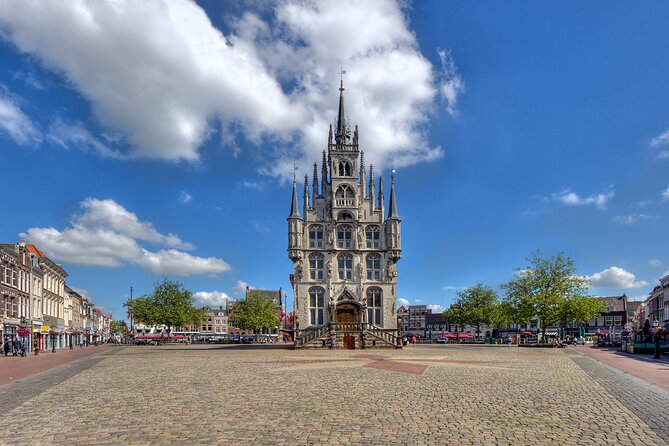
The town hall is one of the walk’s main visual anchors. Built around 1450, this large Gothic building occupies a prominent place on the Markt, the historic central square.
Its location tells you something about old Gouda. The city council wanted an impressive civic building in the center of public life, where trade, administration, and local ceremony came together. You can appreciate the building from the outside as part of the square, even if you do not enter.
The route returns to the town hall as one of its stops, so do not be surprised if the audio brings you back to this landmark. That repeat may help you place the building within the wider route, though it can feel slightly redundant if you are expecting ten entirely separate sights.
Take a moment to look beyond the building itself. The square gives you the clearest sense of Gouda as a historic market town, and it is one of the best places to understand why the city developed around commerce and civic government.
Canals and the medieval shape of Gouda
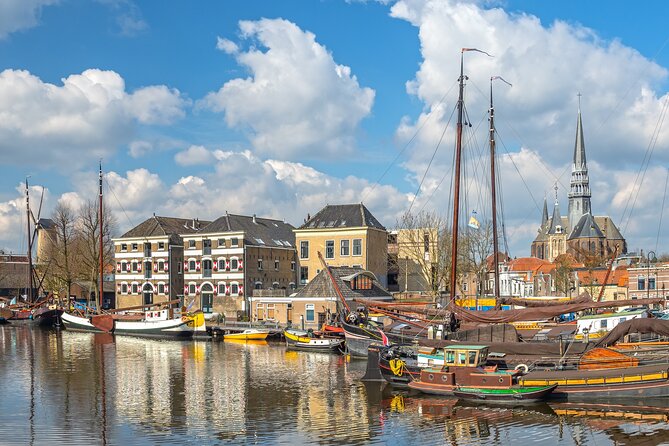
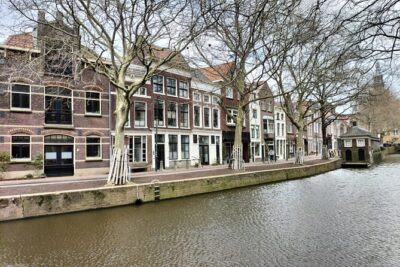
The walk then leads through Gouda’s winding streets and along the Gouwe, the waterway that runs through the city. This is where the experience becomes more than a checklist of monuments.
Gouda began as a modest settlement beside the river and grew into a town connected to waterborne trade. The canals and narrow streets preserve that older pattern. You will see how the water shaped movement through the center and helped goods reach the town.
I like this part because it gives the famous cheese name a physical setting. Gouda was not an isolated village with one celebrated product. Its waterways helped connect the town with the surrounding region, and the old street plan still hints at that commercial past.
The route’s canal sections also provide a change of rhythm. After standing in front of a major building, you can walk beside the water and look at old facades from a different angle. A short city walk can feel much more personal when it includes ordinary streets as well as headline sights.
The route does not promise an extensive walk outside the central area. Its strength is concentration. In two hours, you get a useful introduction to the old town rather than a broad survey of the entire region.
Cheese, the Waag, and Gouda’s most famous name
Gouda cheese is the city’s best-known calling card, and the route gives it more context than a quick photo beside a shop sign. You will visit the area connected with the cheese trade and hear how local farmers brought their cheeses to market.
The historic cheese market was held at the Waag, where the famous rounds were traded. Farmers from the surrounding area brought cheese by horse-drawn cart. The market was not just a colorful tradition. It was a working part of the local economy, linking rural producers with buyers in the town.
The Waag is especially useful for understanding how the city’s name became attached to a product known around the world. The cheese story connects the waterways, the Markt, the farmers outside town, and the merchants inside it.
Do not assume that a scheduled live cheese market is included. The route takes you to the historic cheese-market setting and explains its importance, but the supplied details do not promise a current market performance or special tasting.
At this price, the cheese stop works best as cultural context rather than a food tour. If you want tastings, a shop visit, or a market event, you would need to arrange that separately. Still, for a few dollars, the audio story gives the cheese a sense of place.
Same region, a different board:
- Gouda: Gouda Cheese Experience Entry Ticket
★ 4.6 · 578 reviews - 2-Hour Walking Tour in Gouda All inclusive
★ 5.0 · 48 reviews - e-Scavenger hunt Gouda: Explore the city at your own pace
★ 4.5 · 19 reviews - Gouda: Guided Walking Tour
★ 4.7 · 16 reviews
St. John’s Church and its remarkable glass
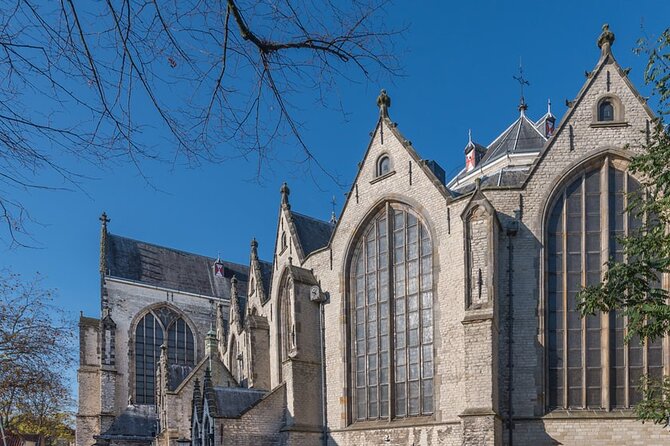
St. John’s Church is dedicated to John the Baptist, Gouda’s patron saint. It is one of the route’s most important religious and artistic stops.
The church is known for its stained-glass windows, called the Gouda Glass. The audio explains the symbolic use of white and red associated with John the Baptist. White represents purity and love, while red represents suffering. Those colors recur in the windows and give the church’s decoration a clear visual language.
This stop rewards a slower pace. A GPS walk can tempt you to listen, glance at a facade, and move on. Here, you should give yourself time to look carefully if the church is open and access is available when you visit.
The provided information does not guarantee entry conditions or opening hours, so the audio portion may be more dependable than an interior visit. Even from outside, the church helps show the scale and importance of Gouda’s religious center.
I like that this stop broadens the route beyond cheese and canals. Gouda’s identity also comes from faith, civic life, art, and architecture, and St. John’s brings those parts together.
Museum Gouda and the Catharina Gasthuis
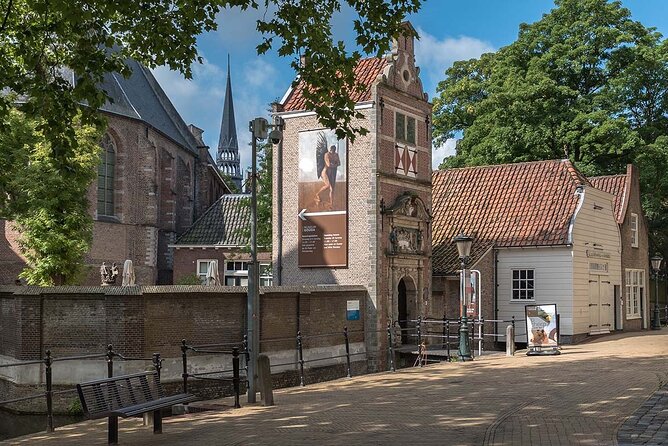
Museum Gouda traces its municipal origins to 1874, when it was founded as the Municipal Museum of Gouda. It first occupied the Arti Legi building on the Markt before the collection moved in 1947 to the Catharina Gasthuis.
That background gives you a useful glimpse into how a local collection develops. A museum can begin as a civic project, change buildings, and take on a broader role as the town’s idea of its own past grows.
The route introduces the museum from the outside and explains its place in Gouda. It does not state that admission is included, so you should not treat this as a museum entry ticket or a guided indoor tour.
If you have extra time after the audio walk, the museum may be worth considering separately. The walk gives you the setting and basic story first, which can make a later visit more meaningful. If you are only in town for two hours, the exterior stop still adds cultural depth without requiring a long indoor visit.
The Swanenburghshofje courtyard
The Swanenburghshofje is one of the more distinctive stops because it shifts the focus from public monuments to a smaller residential courtyard.
Its story begins more than 330 years ago. On April 27, 1689, Elisabeth Nathans Bars, the widow of timber merchant Noach Cornelisz Swanenburgh, established the courtyard. The site reflects a long Dutch tradition of charitable housing and privately supported community spaces.
A hofje can be easy to miss when you are hurrying between major sights. That is why I value its inclusion. The courtyard offers a quieter look at how people lived and how wealth could be directed toward housing and care.
Be respectful here. A courtyard is not the same as a public square, and access may depend on local conditions. The supplied information identifies it as a stop but does not promise unlimited entry or a full interior visit.
This is also one of the places where a self-guided route can work well. You can pause, listen, and look closely without needing to keep up with a group.
Museum Harbor and Gouda’s working waterways
The Museum Harbor of Gouda focuses on historic transport ships. Many of the vessels date from around 1900 and were built for inland sailing.
This stop ties neatly back to the Gouwe and the city’s commercial past. Gouda’s canals were not just attractive scenery. They formed part of a working transport network, and the ships in the harbor help you picture the scale and character of that traffic.
The harbor adds variety to the walk. After churches, civic buildings, and cheese history, you get boats and water. It also helps explain why a town away from the open sea could still have a strong maritime connection through inland routes.
The details provided do not say that you board the ships or receive a separate harbor tour. Expect an exterior visit and audio information rather than a guaranteed onboard experience.
The Admiral’s House and Rococo detail
The Admiral’s House is a high, narrow building with an unusually fine Rococo interior. Its history can be traced back as far as the 14th century, with later building and interior elements adding to its character.
This stop gives you another look at Gouda’s historic housing. The building is not described as a large palace or civic monument. Its interest comes from its narrow form, long history, and decorative interior.
That makes it a good companion to the Swanenburghshofje. One shows a shared courtyard shaped by charity, while the Admiral’s House points to private wealth and domestic design.
The important limitation is access. The route can explain the house and show you its exterior, but the information does not promise entry into the Rococo interior. If you care especially about interiors, check local opening details before relying on this walk alone.
What $8.32 gets you in two hours
At $8.32 per person, the experience is priced more like a compact audio guide than a full guided tour. You are paying for a structured route, GPS directions, and commentary in your chosen language, not for a guide who walks beside you.
That is strong value if you want orientation and historical context at a low cost. The route covers a lot: a medieval town hall, canals, Gouda’s cheese trade, a major church, a museum, a courtyard, a harbor, and a historic house.
The value is weaker if you expect personal conversation, detailed answers, or guaranteed entry to every building. You also need to supply your own attention and keep track of the route when GPS drifts.
The private format is useful for couples, families, or friends who want to stop when they like. Since only your group participates, you do not have to match the pace of strangers. That freedom is the main advantage over a conventional group walk.
The route is booked about 19 days ahead on average, which suggests that planning early can be sensible during a busy visit. Confirmation arrives at booking, and free cancellation is available up to 24 hours before the start time. Inside that 24-hour window, refunds are not provided and changes are not accepted.
Who should choose this Gouda walk
I would choose this experience if you want a first look at Gouda and prefer to explore independently. It suits you especially well if you like history in small portions, want an affordable activity, or need a tour that starts and ends near public transportation.
It also works for a private group with mixed interests. One person can focus on cheese, another on architecture, and another on canals, while the GPS route keeps everyone moving in the same general direction.
You should think twice if you want a live guide, a food tasting, or a full indoor tour of the church, museum, ships, and historic houses. Those elements are not promised.
Bring a charged phone and leave enough attention for navigation. If the route’s GPS point looks slightly off, use the surrounding streets and landmarks to confirm where you are. The walk is designed to be manageable, but it is not completely hands-free.
Should you book it?
Book this Gouda walk if you want an inexpensive, private introduction to the city’s old center. The combination of canals, cheese history, St. John’s Church, the Markt, a historic courtyard, and the Museum Harbor gives you a broader picture than a cheese-only outing.
Skip it if your priority is a live storyteller, tastings, or guaranteed access inside every building. For $8.32 and about two hours, though, it offers a sensible way to get oriented, hear the key stories, and return to Gouda Station without committing half a day.
FAQ
Where does the self-guided Gouda tour start?
It starts at Gouda Station, Stationsplein 11, 2801 AK Gouda, Netherlands.
Where does the activity end?
The walk ends back at the meeting point at Gouda Station.
How long does the tour take?
The approximate duration is two hours, including travel time between the stops.
Is this a private tour?
Yes. Only your group participates in the activity.
Is the tour available in different languages?
The GPS and audio system provides directions and information in your own language.
Can I cancel for a full refund?
Yes, if you cancel at least 24 hours before the experience start time. Cancellations made within 24 hours are not refunded, and changes during that period are not accepted.
New cheese trips in Gouda
- e-Scavenger hunt Gouda: Explore the city at your own pace★ 4.5 · 19 reviews
- Discover Gouda with a self-guided Outside Escape city game tour!★ 5.0 · 13 reviews
- Escape Xperience in Gouda: The Legend of Jacoba★ 5.0 · 2 reviews
- Self-Guided Walking Tour of Gouda: Canals, Colonies, and Cheese★ 5.0 · 3 reviews
- 90 Minutes Self-Guided Family Friendly Walking Tour in Gouda★ 5.0 · 2 reviews
- Historical Gouda: Private Tour with Local Guide★ 5.0 · 2 reviews
- Gouda Cheese and Delft Blue: Full-Day Private Tour★ 5.0 · 4 reviews
- Gouda Private Walking Tour: History, Architecture & Cheese★ 4.5 · 8 reviews
Gouda Cheese Tours, compared.
Discover Gouda with a self-guided Outside Escape city game tour!
Read our review →
Gouda Private Walking Tour: History, Architecture & Cheese
Read our review →
Gouda Cheese and Delft Blue: Full-Day Private Tour
Read our review →Browse the lists this tour appears in